Services • 03 of 03
Manual therapy creates An opportunity
Targeted, hands-on soft tissue work - deep tissue release - myofascial release, trigger point therapy, and nerve mobilization - for active adults in Clackamas, Milwaukie, Happy Valley, Lake Oswego, West Linn, Oregon City, Damascus, Boring, and greater Portland. This is the bridge been immediate pain relief and permanent pain relief.
The Outcome
How Manual Therapy Will Actually Help You.
A chiropractic adjustment can restore motion at the joint. But the muscle, fascia, and nerve tissue around that joint have spent months — sometimes years — holding the old pattern. If we don't address the tissues it's like driving down the highway with the parking brake on.
The goal of manual work is not to feel better - because that relief will only last a day or two. The goal is to create a window of musculoskeletal and nervous system changes for us to take advantage of throughout the rest of the session.
Manual therapy is the hands-on layer that addresses the soft tissue side of the equation. At I.MOVE., the clinician delivering your manual therapy is the same doctor doing your adjustment and writing your rehab program — so the soft tissue work is precisely targeted to what your body needs to make the rest of the plan land.
Inside a typical 60-minute visit, manual therapy might include:
• Deep tissue release for the chronic muscle guarding that's been driving recurring tension, soreness, and "knots that never go away"
• Trigger point therapy for the referred pain patterns that keep coming back to the same spot — the shoulder blade, the glute, the lateral hip — no matter what you stretch
• Myofascial release for the layers of fascia that have stuck together, creating the "tight" feeling that more stretching never seems to fix
• Nerve mobilization for the entrapments driving tingling, numbness, pins-and-needles, and sciatic-style symptoms down the leg or arm
• Instrument-assisted soft tissue mobilization (IASTM) and Rocktape kinesiology taping where added support is the right call between visits
For our patients, the outcomes look like:
• Chronic neck and upper back tension that finally quiets down — instead of the 24/7 low-grade tightness behind every workday
• Piriformis-driven sciatica released at the actual source, so the leg stops going numb on long drives
• Plantar fasciitis addressed where it's almost always living — in the calf, the posterior chain, and the foot's own deep tissue
• Frozen shoulder and post-injury shoulder restriction opened up enough to start rebuilding overhead range
• Tennis elbow, golfer's elbow, and forearm tightness addressed at the fascia and trigger points that desk work and grip-heavy lifting have created
• Tingling, numbness, or pins-and-needles that have been brushed off as "you're just getting older" — when it's usually nerve tissue that needs to glide again
Patterns we work with
Common Drivers
Manual therapy is woven into every I.MOVE. visit. These are the patterns where it does the most work — and where most patients have tried "just deep tissue" without long-term change.
Trigger points
Fascial restriction
Piriformis syndrome
Frozen shoulder
Plantar fasciitis
Tennis elbow
Nerve entrapement
Sciatica
Why this is one lateral, not THE layer
Releasing fascia is satisfying. Alone, it's also temporary.
Adjustments and manual therapy creates a window of improved range of motion and decreased pain. rehab takes Advantage of the window to create lasting changes
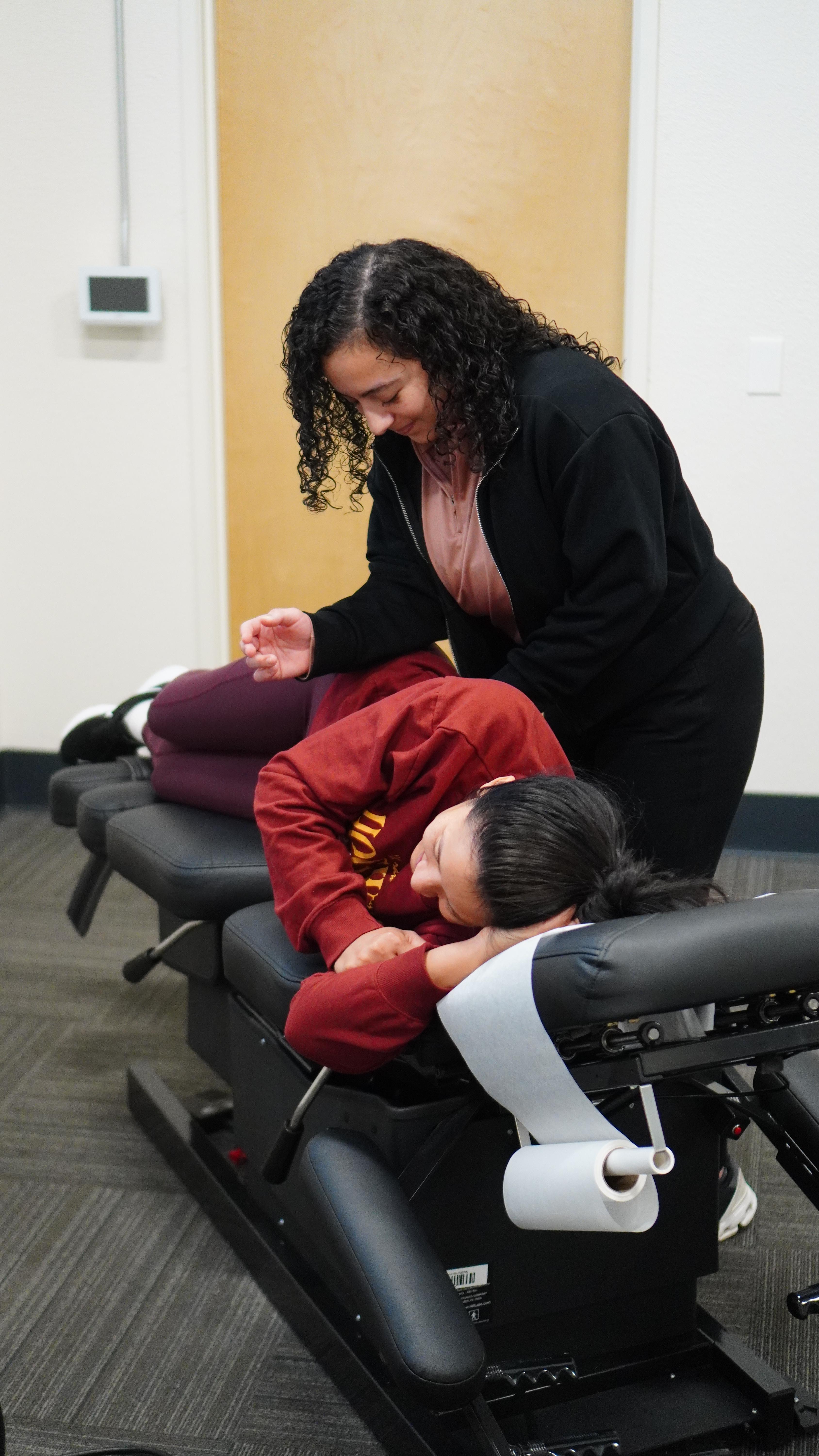
Here's the mechanism almost every "just deep tissue" practice misses: when you release the soft tissue holding a joint in a poor position, the joint now has the option to move better — but only if the joint itself isn't restricted, and only if the nervous system has been retrained to use the new range. Skip either of those, and within a few days the same muscles gett tight again, the same pattern, because nothing taught the system to choose differently.
That's why every 60-minute visit at I.MOVE. is fully integrated. The manual therapy releases the tissue. A chiropractic adjustment restores the joint. And sports rehab uses that combined window — better tissue, better joint motion — to retrain how your body actually moves and loads in real life creating lasting changes in pain perception and flare up prevention.
If you've had massage every two weeks for years and still wake up with the same upper back pulling, this is what's been missing. The tissue work was correct. It just wasn't the whole answer.
I.MOVE. Health and Performance
Conditions Treated:
Low Back Pain
Sciatica
Knee Pain
Hip Pain
Shoulder Pain
Neck Pain and Numbness
Speciality Results:
Help people get back to lifting weights pain free
Support strength training and powerlifters in competition
Improve speed and distance in runners
Eliminate pain after failed chiro/ PT, injections, and surgery
Get in the best shape of your life without pain holding you back


UPCOMING EVENTS!
Every month we host FREE events for those in our community to gain clarity as to why they're dealing with pain and flare ups