Services • 02 of 03
Sports rehab that is more than just stretches and exercises.
This is where short-term relief becomes long-term capability. Strength and mobility can take months and multiple visits a week. Making changes to imbalances and compensation patterns can change in weeks.
This is where our education- based rehab is set apart.
Making lasting movement and activity changes for lifters, runners, CrossFit athletes, and active adults across Clackamas, Milwaukie, Happy Valley, Lake Oswego, West Linn, Oregon City, Damascus, Boring, and the greater Portland area.
The Outcome
how proper rehab helps you reach your goals.
Pain free is not end goal - you back to lifting, running, hiking, playing pain-free is the goal
Sports rehab isn't a photocopied sheet of stretches and exercises handed out to everyone. It should be real programming — a unique and custom plan geared towards re-educating the body.
Most rehab stops the moment a patient says "it doesn't hurt anymore." We don't. The end of pain is the start of the work that actually matters — the work that takes a body still moving around an old injury and turns it into one that doesn't even think about it anymore.
That work is sports rehab. Inside every 60-minute I.MOVE. visit, after the adjustment has restored joint motion and the manual therapy has released the soft tissue holding the old pattern, education-based rehab uses that combined window to retrain how your body moves and loads in the real world. That's where the change becomes permanent.
For lifters and CrossFit athletes, that looks like getting back to deadlifts, squats, and overhead pressing without flare-ups — with mechanics that protect the spine and shoulders for the next twenty years of training. It looks like rebuilding after a low back injury, a rotator cuff issue, a shoulder impingement, a flared-up wrist, or a tweaked knee — and trusting the next heavy session in a way you haven't in months.
For runners, it looks like finishing long runs without IT band syndrome, runner's knee, or hip pain. Running gait that doesn't hurt. Return to mileage after plantar fasciitis, shin splints, Achilles tendinitis, or hamstring strain that doesn't flare up when training volume goes back up.
For active adults past 40, 50, 60, it looks like hiking weekends, ski seasons, gardening, traveling, and grandkid-chasing without the body negotiation. Long-term load management — strength, balance, mobility — that lets you stay strong, independent, and capable for decades.
Our Rehab Process
What is Education-Based Rehab?
Most of the rehab people do is either to get stronger or more mobile...
But what if you don't have a strength or mobility issue?
What if the reason you wake up with pain or pay the price after a workout is a coordination deficit (you're unable to coordinate your rib cage and pelvis) or you're compensating for another body part that's not doing it's part?
That's why our patient's actually are able to get back to doing the things they love - because we address the root cause and teach them how to fix the imbalances causing the pain in the first place.
Specific patterns we rehab every week include: low back pain from lifting, rotator cuff dysfunction, ACL rehab continuation, hamstring strains, plantar fasciitis, tennis elbow, recurring ankle sprains, patellar tendinopathy, post-concussion syndrome, postural and chronic neck pain, and the kind of recurring tweaks that have started to feel like part of who you are.
Why rehab can't do it alone
You can't rebuild coordination in a body that's stuck.
Adjustments create the range of motion needed. Manual therapy makes the range usable. rehab makes it permanent.
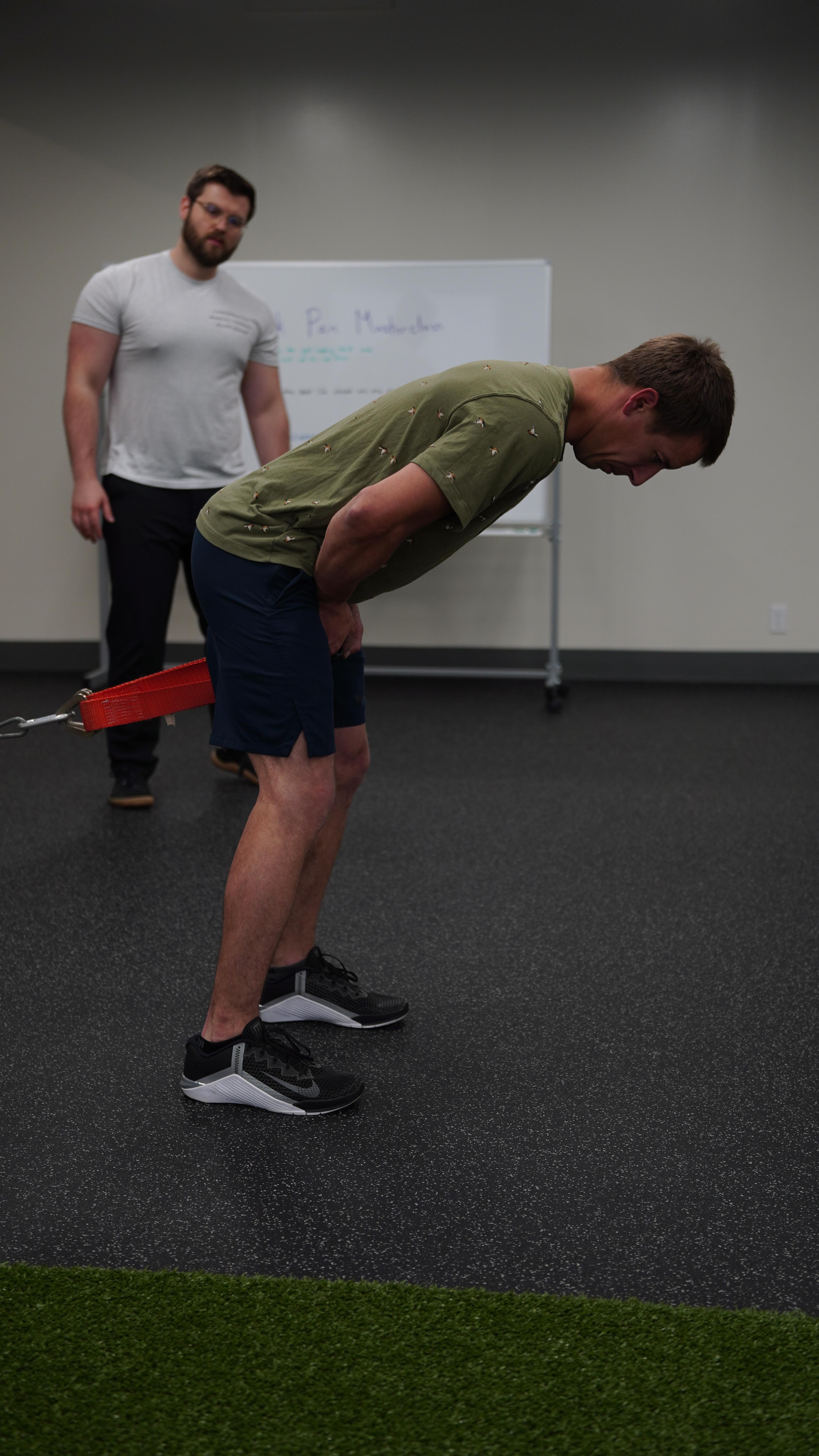
Here's why pure rehab — even excellent rehab — so often plateaus: a locked-up joint won't load well, a muscle that's been avoided for six months won't fire on cue, and a nervous system that's been bracing around an injury can't be coached out of that pattern with sets and reps alone. You can program around it, and most clinics do, but you'll be working uphill the whole time.
That's why we run all three together in one 60-minute visit. Chiropractic adjustments improve range of motion that rehab uses. Manual therapy releases the soft tissues so they can fire with optimal strength. And the rehab turns the change into something your body knows how to do without thinking. This is how we have such a high patients success rate.
Our goal is graduation. We want patients to need us less over time, not more. That only happens when the joint, the tissue, and the movement pattern all get addressed in the same hour, by the same doctor, every visit.
I.MOVE. Health and Performance
Conditions Treated:
Low Back Pain
Sciatica
Knee Pain
Hip Pain
Shoulder Pain
Neck Pain and Numbness
Speciality Results:
Help people get back to lifting weights pain free
Support strength training and powerlifters in competition
Improve speed and distance in runners
Eliminate pain after failed chiro/ PT, injections, and surgery
Get in the best shape of your life without pain holding you back


UPCOMING EVENTS!
Every month we host FREE events for those in our community to gain clarity as to why they're dealing with pain and flare ups